Listen to this article
Read by an AI-generated voice · Report a mispronunciation
A new study asks what caste does to a farmer’s income once the land is theirs: at the counter where inputs are bought, and at the trader’s scale where the crop is sold.
The study is “Caste discrimination and returns to farming: Evidence from Maharashtra,” by Nageshwar Bansode and Madhura Swaminathan, in the Development Policy Review, volume 44, issue 5, 2026. Its authors write that large surveys and village studies consistently find that Scheduled Caste households earn less from farming than others, but little is known about the practices behind the gap. (Scheduled Castes is the Indian government’s official category for Dalit communities, among those once branded “untouchable”. The authors use the two terms interchangeably.)
Two villages, one ledger
The primary author did the fieldwork in 2019 and 2020 in two villages in Nanded district, in the western Indian state of Maharashtra, the paper says. Nanded lies in Marathwada, a region the authors call underdeveloped within an otherwise high-income state. Scheduled Castes are 20% of Nanded district’s population, according to the paper, and the two villages were chosen because they are far more Dalit than that. The authors ranked all 1,530 inhabited villages in the district by Dalit share of the 2011 Census population, and, after on-site visits to the top five, chose the top-ranked and the third-ranked.
Most earlier work on caste discrimination in farming looked at villages with several castes. The authors say theirs is the first study of discrimination in agriculture in villages where Dalits are the large majority and farm for a living.
Shendan, in Hadgaon tehsil (a subdistrict), has 126 households. All belong to the Mahar Scheduled Caste. Many families were long-term landless workers who later acquired land. The village has no health facility or store.
Bachoti Kamp, in Bhokar tehsil (a subdistrict), has 101 households, 100 of them Mang (Matang), a Scheduled Caste. Families displaced by a dam settled it on gairan, or grazing, land. It has no public transport and no household with tap water.
The authors, they write, counted every household, then surveyed a random sample of 30 in each village on assets, work and income. In late 2020 they interviewed three key informants in each village and held a focus group of six or seven cultivators in each.
The ledger of prices
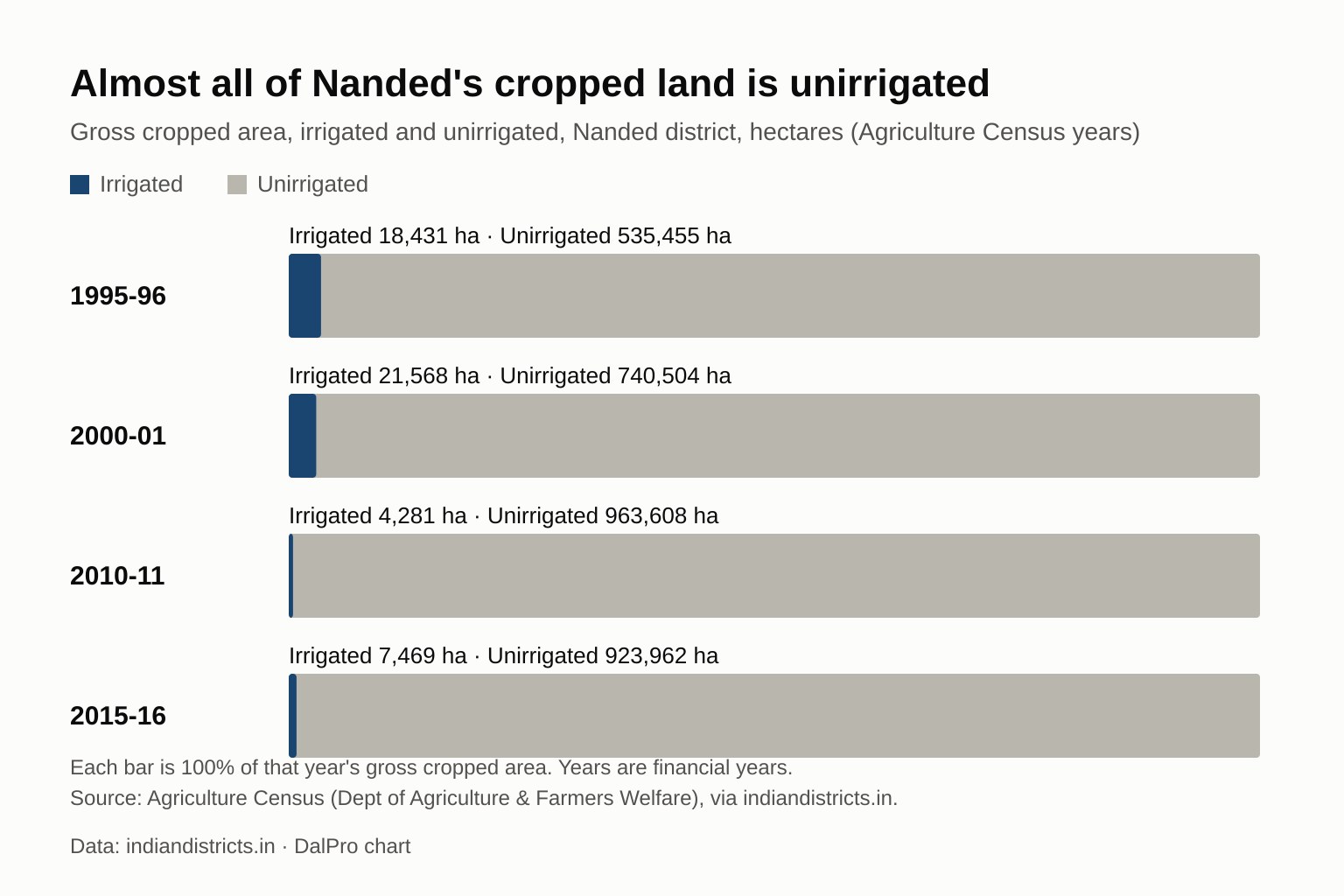
Farming pays little in either village, the paper finds. In Shendan the mean crop income was Rs 42,297 (about US$570 at 2020 rates) a year, which the authors put at 37% of the average for Maharashtra as a whole. In Bachoti Kamp it was Rs 3,288 (about US$44), with a median of Rs 393 (about US$5.30), and 12 households lost money. The paper’s table puts Bachoti Kamp’s net income from soybean at minus Rs 1,715 (about US$23) a hectare. The authors say poor soil and a lack of irrigation are part of the reason: in Shendan only about 3% of the net sown area is irrigated, and in Bachoti Kamp none is.
On top of that, the study documents discrimination in what farmers buy and what they sell. Its paired prices make the pattern concrete.
- Urea. A farmer from Shendan paid 260 Indian rupees (Rs 260, about US$3.50 at 2020 rates) for a 50 kg bag. A Maratha farmer, a member of the dominant caste, paid Rs 250 (about US$3.40) the same day.
- Sorghum seed. A respondent bought a 30 kg bag in Bhokar market for Rs 2,600 (about US$35). The same day a Maratha buyer paid Rs 2,400 (about US$32).
- Insecticide. A Bachoti Kamp respondent paid Rs 668 (about US$9.00) for a can. The same dealer sold it for Rs 550 (about US$7.40) to buyers from a non-Dalit village a few kilometres away.
- Tractor hire. Bachoti Kamp cultivators paid Rs 1,000 (about US$13) an acre for land preparation, against Rs 750 to Rs 900 (about US$10 to US$12) for the same service in Bhosi.
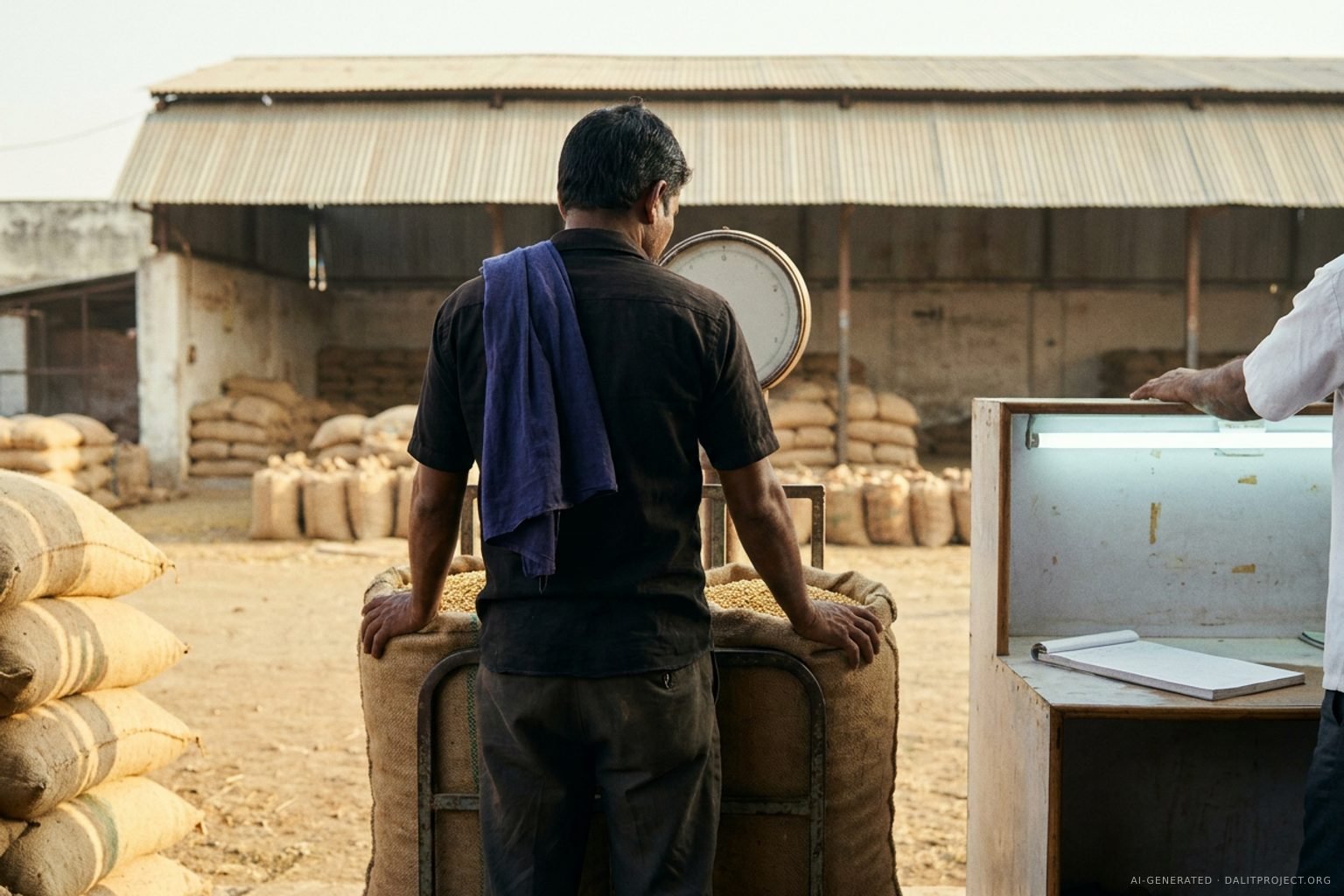
- Soybean. A Dalit cultivator in Bhokar market was paid Rs 2,600 (about US$35) a quintal, which is 100 kg. He later learned that a farmer from the Other Backward Classes (OBC), an official category, was paid Rs 2,800 (about US$38) the same day.
Threshing soybean cost Bachoti Kamp cultivators Rs 250 (about US$3.40) a quintal against Rs 200 (about US$2.70) in Bhosi.
Soybean, Bhokar market: Rs 2,600 (about US$35) a quintal paid to a Dalit cultivator, Rs 2,800 (about US$38) the same day to an OBC farmer. One sale, not an average. Source: Bansode and Swaminathan, Development Policy Review, 2026.
In the soybean sale the gap was Rs 200 (about US$2.70) a quintal, so at that rate it grows with the size of the harvest sold. The urea difference works on the other side of the ledger: it raises what a Dalit farmer spends before there is a crop at all.
Refusals, subsidies and credit
Not every barrier is a price, the paper records. In Tamsa, a shop owner refused to sell sorghum seed, saying it was “a bad omen” for his business. Many auto-rickshaw drivers refused to come to Shendan’s Jay Bhim Nagar because their vehicle might be “polluted”.
i
CC BY 4.0Original on indiandistricts.inPublic schemes missed the villages as well, according to the paper. Subsidised sorghum seed was Rs 1,600 (about US$22) for a 35 kg bag, against Rs 2,500 (about US$34) in a private store. It was sold at a cooperative society in Bhokar and at a government agricultural centre, a Krishi Vigyan Kendra, in Pokarni, and the authors say Dalit cultivators were excluded from subsidised sales because they were not cooperative members. The paper says there was no cooperative society in either village, and cooperatives in neighbouring villages excluded Dalits. No respondent reported buying subsidised fertiliser.
A 2017 scheme for Scheduled Caste farmers, the Dr. Babasaheb Ambedkar Krushi Swalamban Yojana, offers grants for wells, pumps and farm ponds by annual lottery. Several Shendan households applied, but only two have received grants, for open wells.
In Bachoti Kamp, 47 of 77 households farm gairan land that was never registered after it was distributed in the 1970s. Without a title deed they cannot get input subsidies or landowner schemes. The 30 households that do hold title cannot sell without the permission of the district magistrate, the district’s senior administrator, and cannot lease the land out, which limits its use as collateral. According to the manager of the State Bank of India’s Bhokar branch, banks may lend up to Rs 100,000 (about US$1,300) per hectare of registered gairan land; the authors say such loans have not in practice been issued.
Shendan’s cultivators relied on informal lenders. One borrower from a moneylender in Tamsa repaid Rs 150 (about US$2.00) for every Rs 100 (about US$1.35) borrowed, an interest rate of 50%. No farmer in either village had been visited by an extension or agricultural officer. And not one cultivator in Shendan, and not one farmer in Bachoti Kamp, received the government’s announced minimum support price (MSP) for any crop.
In their words
Two accounts in the paper show how the deductions work. A Bachoti Kamp cultivator, interviewed in January 2020, described what happens once a price is agreed with a merchant:
“Once the sale price is decided, the merchant deducts 1 kg for temple prasad (offering) and 1 kg for the local market cleaning worker. If I refuse to give the extra output, then no one will purchase my commodity. … A sad thing is that upper-caste merchants take a share of our commodities in the name of the deity, but we are not allowed into the temple.”
A woman from Bachoti Kamp who buys vegetables wholesale in Bhokar and sells them in a nearby village bought onions and brinjal at Rs 60 (about US$0.81) a kilo and sold them at a loss, for Rs 50 (about US$0.67). She told the authors that she was refused entry to the Patil area of that village on caste grounds, and: “they consider me impure. I am powerless.”
“The stigma of untouchability has restricted their freedom of profession and therefore, their efforts to remove their poverty are not fructifying. In professions like trade and commerce, they are very rarely found. As they can find no place to try for their fortune they are constrained to remain as manual labourers.” — B.R. Ambedkar, jurist and principal architect of the Indian Constitution, first editorial of Mooknayak, 31 January 1920, English translation by B.R. Kamble
Writing in 1920, not about Nanded or this study.
The strongest counter-reading, and the authors’ own caveats
The authors are careful. In the abstract they write that low farm productivity in the area is partly down to regional constraints, including a lack of irrigation, and that they “do not attempt a formal statistical attribution of income differentials.” What they argue is narrower: that the discriminatory practices they document “are likely to increase production costs and reduce net farm incomes for SC cultivators compared to other farmers.” The conclusion adds that the article “does not seek to establish a causal relationship” between specific forms of discrimination and observed costs, yields, prices and incomes, though the evidence “strongly suggests” that multiple forms contribute to low farm incomes in Scheduled Caste-majority villages. Both passages are in the paper.
That caution matters for how the prices are read. They are examples, not a measured average gap, and they should not be charted as rates. The urea, sorghum seed and soybean pairs are same-day sales; the insecticide, tractor and threshing figures compare charges across villages. The sample is 30 households in each of two villages.
A reader who wants to explain a difference away is right to ask for the detail, and the paper records what the traders said. The soybean trader in Bhokar told the cultivator he gave higher prices to large farmers from other castes to maintain social and political ties. A commission agent who paid a Shendan respondent Rs 2,675 (about US$36) a quintal for soybean said, in an interview in January 2020: “Shendan farmers bring low-quality, unclean produce to the market. I cannot give them the market rate.” The paper reports both justifications.
What the study asks policy to do
The authors’ policy conclusion is that farm-income policy should “explicitly recognize and address” these practices. Their abstract names three areas: the minimum support price, the price at which India’s central government offers to buy certain crops; fertiliser subsidies; and investment in irrigation. Their abstract also says the study found discriminatory outcomes in how public policy is carried out, not only in private markets.
In the conclusion they go further. Policy must first address what they call cumulative disadvantage, the historical neglect of Dalit cultivators in land rights, land improvement including irrigation, information and subsidised inputs. Where caste is already named in policy, as in credit targets for Scheduled Caste households, implementation has to improve. Ending discrimination in informal private transactions is a “less tractable” problem, they write, though policy incentives and disincentives can be introduced to counter it, and data on caste discrimination is essential.
What to watch
The study cannot say how far these gaps travel, and two villages cannot settle it. What it does is show where to look when asking why Dalit cultivators earn less: not only at who owns the land, but at the price on the day, the cooperative that will not enrol them, the scheme that never reaches the village and the officer who never visits.