Listen to this article
Read by an AI-generated voice · Report a mispronunciation
What did the reform do?
Kerala, a state in south India, held its farmland under the janmi-kudiyan system: janmis, landlords, owned the land, and kudiyans, tenants, farmed it. The reforms “effectively ended” that system, “provided security of tenure to millions of cultivators, and granted ownership rights to hutment dwellers”, Wikipedia’s summary of the reform records. They are “widely regarded as the most successful and comprehensive in India” (same summary).
Hutment dwellers, kudikidappukar, were “landless laborers living in shacks on the landlord’s property with no legal rights to their home site” (same summary). Under the reform, landless labourers were given 10 cents (a tenth of an acre) of land in village areas and three cents in towns, the scholar Aneesh K.A. wrote in a 2014 study of the reform’s gaps (Homelessness at Home: Call for a Second Land Reform in Kerala). A cent is about 40 square metres, so a 10-cent plot is about 400 square metres.
The Act, passed in 1963, was amended in 1969, Aneesh wrote. The farmland itself went to tenants, “mostly upper and middle-caste citizens”, who “could prove their status as tenants by presenting rent receipts”, Aneesh wrote. “Dalit labourers did not possess these rent receipts.” The law “only covers tenants, which therefore excluded Dalits and Adivasis”, who were not allowed to be tenants under Kerala’s caste hierarchy, he wrote. The 1963 Act also exempted plantations and private forests from the ceiling on how much land one owner could hold (Wikipedia, Chengara struggle), which kept large estates out of redistribution.
Land above the ceiling was meant to go to the landless. By 1989, Aneesh wrote, the government had taken over 92,338 acres, of which 24,333 acres went to Scheduled Castes and 5,052 acres to Scheduled Tribes. Scheduled Castes (SCs) are the communities listed under the Constitution for protection and reservation, most of them Dalits; Scheduled Tribes are Adivasi communities.
Where did Dalit families end up?
Many were housed in settlements built for them. The Laksham Veedu (one lakh, or 100,000, houses) project, launched in 1972, put “a roof over the head for thousands of families across Kerala who failed to receive land even after the famed land reforms Act”, The News Minute reported. Its twin houses of 240 square feet were later criticised for the “ghettoisation of Dalit families” (same report). Kerala has 26,198 housing settlements designated for Scheduled Castes and 6,578 for Scheduled Tribes, The Wire reported in 2024.
Many of these settlements were officially called “colonies” until 2024, when K. Radhakrishnan, then the state’s minister for Scheduled Caste and Scheduled Tribe welfare, ordered, just before he resigned as minister, that the word be dropped from official records. “‘Colony’ is a term coined by oppressors and linked to slavery,” he said (The Wire). Residents can now suggest names; the order offered nagar, unnathi and prakriti instead (The Wire).
Why it matters: what do the numbers show?
India’s Agriculture Census counts operational holdings: the land a farmer runs as one unit, owned or rented. In 2015–16, Scheduled Castes ran 564,700 of Kerala’s 7.58 million operational holdings, 7.4%, and 35,800 of its 1.395 million hectares of operated area, 2.6% (All India Report on Agriculture Census 2015–16, Tables 7.1 and 7.2). The average Scheduled Caste holding was about 0.06 hectares, against about 0.18 hectares for all of Kerala’s holdings, by The Dalit Project’s calculation from the same tables. Scheduled Caste holdings rose 6.1% in number between 2010–11 and 2015–16, and their area by 1.7%.
An older survey measured ownership by community. Based on a 2004–05 study by the Kerala Sasthra Sahithya Parishad (KSSP), a people’s science movement, the Dalit writer Sunny M. Kapikkad pointed out that dominant-caste families owned 1.05 acres on average, Christian families 1.26 acres and Dalit families 0.27 acres, Aneesh’s study reports.
On 1 November 2022, Chief Minister Pinarayi Vijayan, the state’s elected head of government, launched a digital resurvey of land, called Ente Bhoomi (my land), which aimed “to identify and provide plots to over three lakh landless families in the state”, DT Next reported (Onmanorama dates the launch). Three lakh is 300,000. The report does not say how many of those families are Dalit.
What happened at Chengara?
i
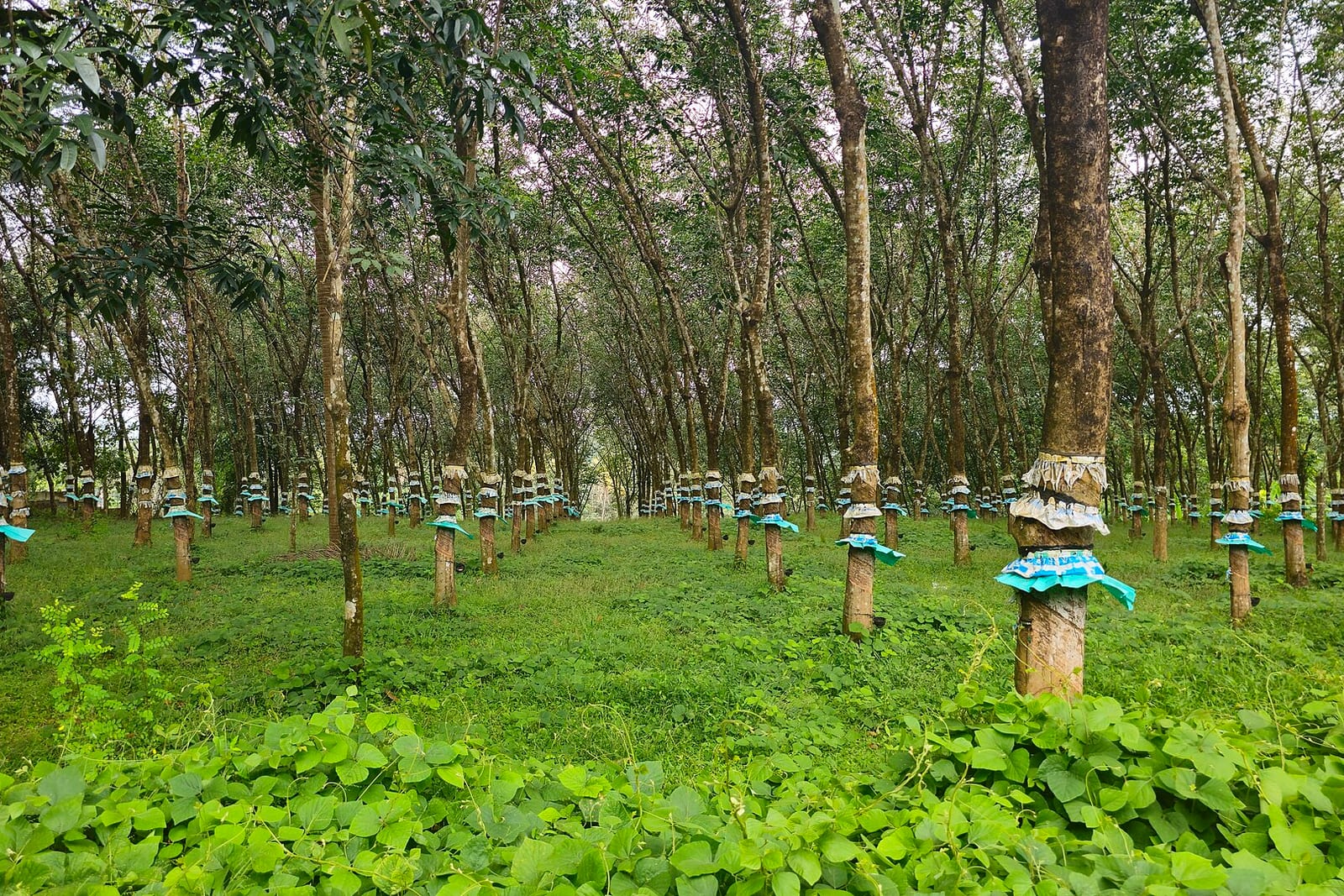
CC BY-SA 3.0Original on Wikimedia CommonsOn the night of 4 August 2007, about 600 landless Dalit, Adivasi and other marginalised families, under the banner of the Sadhu Jana Vimochana Samyukta Vedi (SJVSV) and led by the Dalit activist Laha Gopalan, occupied about 145 hectares of a rubber estate owned by Harrisons Malayalam at Chengara, in Pathanamthitta district, and demanded five acres each, The South First reported in 2025.
In 2009, the government announced the Chengara Package, offering 831.03 acres across ten districts to 1,495 eligible families. Many rejected the plots as rocky and unviable (same report). In 2022, the Kerala High Court, the state’s highest court, said that “it is the sovereign obligation of the State to honour the commitments under the agreement in question”, after the state told it that land available for assignment was scarce (LiveLaw). In September 2025, the Chief Minister directed officials to speed up the rehabilitation of 1,136 families still in the area, the Press Trust of India news agency reported.
“There is this right to life, which is a fundamental human right, and it has also been guaranteed in our Constitution. But this has been denied to some 600 families for the past 18 years,” the SJVSV’s president, K.S. Gopi, told The South First.
What happened at Malayidom Thuruth?
In Malayidom Thuruth, near Kizhakkambalam in Ernakulam district, seven families from the Pulaya caste, a Scheduled Caste community, trace their claim to Kalukurumban, a bonded labourer who lived on the land about a hundred years ago, The News Minute reported. A private claimant won a decree of title to the parcel, about 2.6 acres (Onmanorama), and India’s Supreme Court upheld it (LiveLaw).
On 20 May 2026, nearly 200 police officers arrived to carry out the eviction, after the Munsiff Court in Perumbavoor set them a deadline to complete it, and many Dalit residents were injured during the eviction attempt, The News Minute reported. K.A. Thulasi, the state’s Minister for Backward Classes Welfare, said “the government immediately intervened to halt the police proceedings” (same report). The report carries no comment from the police. “For a few seconds, I thought I had died,” said Chandran, 74, one of those injured (same report). “We have lived here for five generations. How can we possibly move from this place?” Abin Thankachan, a resident, told The News Minute.
In June, the families, the landowners and the state government reached a settlement under which each family would get five cents on the same property and a house built by the government within a year, Onmanorama reported; it was to be signed and filed in the High Court. “We have no other option,” Saji P.T., a resident, told Onmanorama. On 6 July 2026 the Kerala High Court closed the petition before it, after it was told the parties had reached a settlement. It directed the Munsiff Court in Perumbavoor, where the eviction proceedings are pending, to defer them for a year, and recorded that the settlement’s terms had to be updated within a month (LiveLaw). “If there is any violation by anybody, the decree order can move,” the court said (same report).
What do Dalit voices say?
“The so-called Land Reforms Act that was pioneered by the Left in Kerala ironically did not cater to the marginalized communities -including plantation workers- who actually work the land. Only the upper castes benefit from it.”
— M. Geethanandan, Dalit activist, to The News Minute, 2016
Key terms
- Janmi and kudiyan: landlord and tenant under the system the reform ended.
- Kudikidappukar: hutment dwellers, landless labourers living on a landlord’s property.
- Cent: a hundredth of an acre, about 40 square metres.
- Operational holding: the land a farmer runs as one unit, owned or rented.
- Scheduled Castes: the communities listed under the Constitution for protection and reservation, most of them Dalits.
- Lakh: 100,000.
What’s next
Kerala’s reform made tenants into owners. For many Dalit labourers it delivered a house plot at most, and by Aneesh K.A.’s account Scheduled Castes received about a quarter of the surplus land the state had taken over by 1989. The Agriculture Census shows Scheduled Castes running a sliver of the state’s farmed land half a century on. At Chengara families demanded five acres each, and at Malayidom Thuruth they settled for five cents each; the struggle for land goes on. At Malayidom Thuruth, the eviction proceedings stay in abeyance until July 2027, and the government’s houses are due within a year of the June 2026 settlement.