Listen to this article
Read by an AI-generated voice · Report a mispronunciation
The issue
On 1 October 2016, Cordite Poetry Review, an online poetry journal published in Australia, released a special issue titled Dalit / Indigenous Australian. Dalits are the communities once branded “untouchable” under India’s caste order; Adivasis are India’s Indigenous peoples. The issue was edited by Mridula Nath Chakraborty and Kent MacCarter, Cordite’s managing editor, and grew out of Chakraborty’s project Literary Commons: Writing Australia–India in the Asian century with Dalit, Indigenous and Multilingual Tongues, according to their editorial.
The rule of the issue was simple. “Each Indigenous Australian poem is translated into an Indian language,” the editors wrote, and each Dalit and Adivasi poem appeared in its original language beside a translation. “Forty translators were engaged,” the editorial says. The record of the issue at Monash University in Melbourne gives the full count: 25 Indigenous Australian writers, 25 Dalit and Adivasi writers from India and one Indigenous writer from Nepal (the editorial counts those 26 together), with 51 translations in 24 languages. The 51 poems are listed on the issue’s contents page.
51 translations, 40 translators, 24 languages: one issue of an Australian poetry journal, October 2016. Source: Monash University research record.
Who held the pen
Ajay Navaria’s own work had travelled the other way. His Hindi short stories, translated into English by Laura Brueck as Unclaimed Terrain, came out in 2013, and the Australian press Giramondo published them in 2015. In the Cordite issue, Navaria is the translator. He put “Thai”, a poem by the Aboriginal writer Graham Akhurst, from English into the Devanagari script of his own Hindi. Akhurst, whose contributor’s note places him among the Kokomini people of northern Queensland, writes of a night walk to the home of a companion who is “white / yet / blacker than me”, and of not thinking about it. Navaria, who teaches Hindi literature at Jamia Millia Islamia, a university in Delhi, has said he refuses easy sides in his own fiction. “For me, the characters are always grey, whether Brahmins or Dalits,” he told an interviewer from The Hindu in 2018, Brahmins being the priestly caste at the top of the caste order.
Urmila Pawar, who writes in Marathi, the language of the western state of Maharashtra, and whose fifty years of work The Dalit Project profiled in September, translated a poem by Marie Munkara into Marathi. The poem is addressed to someone who has died, and asks whether they had regrets. It ends with the speaker’s own regret: “that I never had the chance / to forgive you”. Pawar’s contributor’s note in the issue says she “learned early in life the meaning of her subordination as a woman and as a Dalit”. A Dalit feminist writer chose the words, in her own language, for an Indigenous Australian poet’s poem about harm and forgiveness.
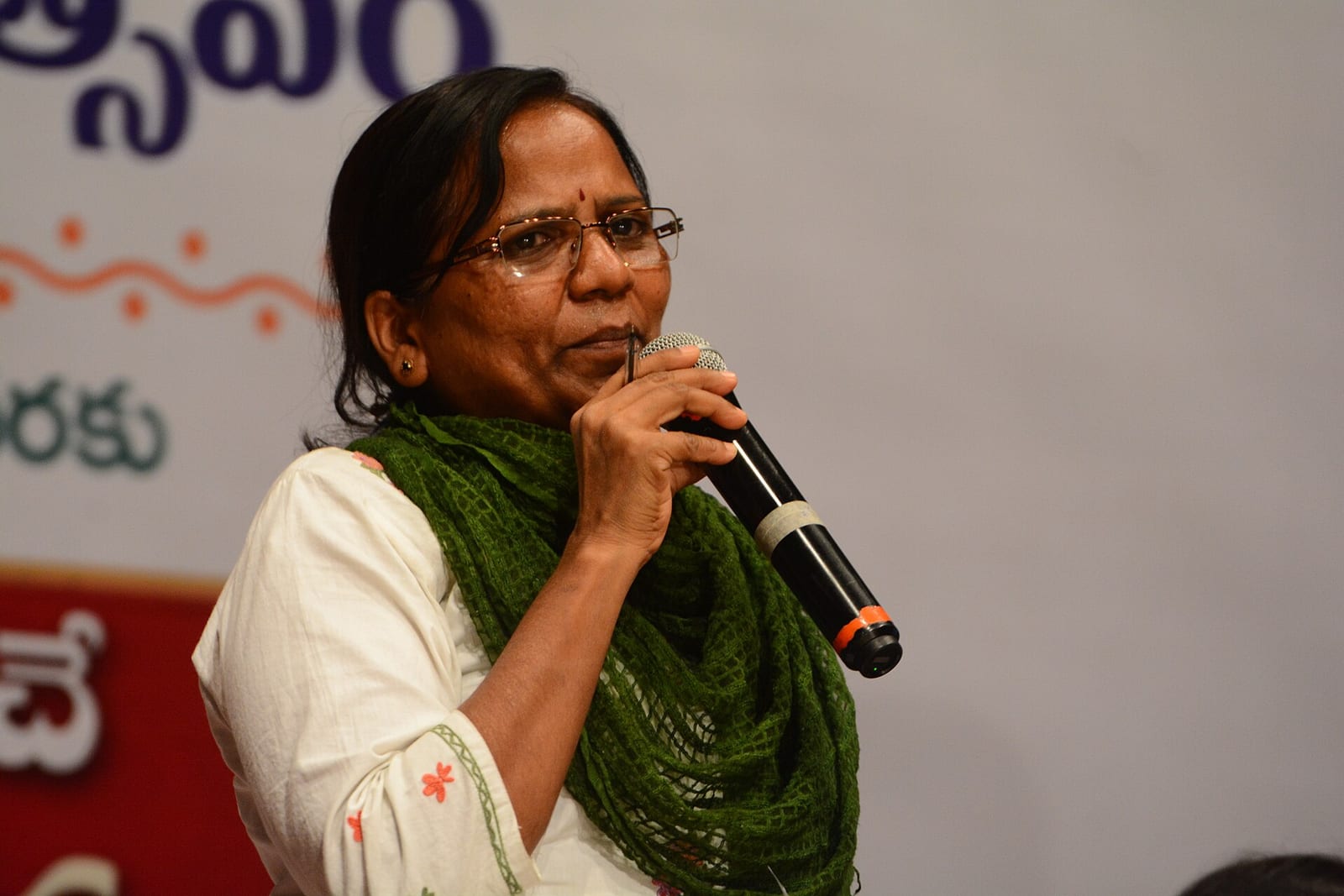
Joopaka Subhadra appears in the issue twice, as poet and as translator. Her own poem in Telugu, a language of the southern states of Telangana and Andhra Pradesh, “Avva’s Stack of Grief”, is in the issue in K. Purushotham’s English. It is a portrait of her mother, avva in Telugu, built from her labour: sweeping, smearing dung-water on the yard, “planting and weeding in knee-deep paddy fields”. Subhadra, whom the issue’s notes call “a powerful Dalit woman writer and an activist”, in turn translated “We’re Here” by Natalie Harkin, a Narungga poet and researcher at Flinders University in Adelaide, into Telugu. Harkin’s poem is a list of who Aboriginal people are to the country around them: “doctors”, “cleaners”, “bus-drivers”, “nieces”, “nephews”, “your next-door-neighbours”. Its refrain is “we’re here! / until your bitter end”. Read together, both are poems of presence that name the work their people do.
i
CC BY-SA 4.0Original on Wikimedia CommonsThe exchange reached past the languages India counts as official. Kamlesh Gayakwad, whom the contributor’s note describes as an Adivasi writer from Navsari district in the western state of Gujarat who documents the oral traditions of the Kunkana and Varli languages, translated “Flight Feathers” by Ellen van Neerven, a Mununjali writer from the Australian state of Queensland, into Kunkana; the issue’s credit line spells his name Gaekwad. The editors wrote that Kunkana, with Dehwali and Chaudhari-Bhili, was one of the “not-as-yet-official languages of India” in the issue. Other Indian poets in the issue also crossed over as translators: the Gujarati and Urdu poet Jayant Parmar put Tony Birch’s “With Rebecca” into Urdu, and Chandrakanta Murasingh, a poet from Tripura in north-eastern India, put Jim Everett’s “Twi / Water Drops” into Kokborok, a language of Tripura.
“I also write to dispel this myth that Dalit writing is somehow wanting in craftsmanship — I work hard to ensure that my stories lack nothing in terms of craft.”
— Ajay Navaria, Hindi writer, interviewed by G. Sampath and translated from Hindi by him, The Hindu, 2 November 2018
What the editors said does not carry across
The editors did not claim that Dalits and Aboriginal people share one condition. They wrote that Dalit and Adivasi writings “have remarkable affinities with Indigenous Australian writing”, and set limits on that in the same breath. “Tribals are distinct from Dalits in that their cultures predate and sit outside of Hinduism,” they wrote, and “there are important and incommensurable distinctions between Dalits and tribals”. They noted that “it has sometimes been argued that Indigenous Australian literatures have more in common with tribal literatures of South Asia”. Their answer was narrower than kinship of origin. “As can be seen in this special issue,” they wrote, “the concerns raised by Dalit poets too resonate powerfully with the assertions of identity and sovereignty of Indigenous Australians.”
That distinction matters. The editors define Adivasis by origin: each group is the “autochthonous people of a given region”. They define “Dalit” by politics, as “the political term of self-identification and choice for those once deemed ‘untouchable’”. The link the issue draws for Dalit writers is assertion, the demand to be seen and heard on one’s own terms, not a shared origin story.
The strongest objection
A fair objection is that this was one academic’s project, recorded as Monash University research, and a single issue of a journal: solidarity on paper, among a few dozen writers. The editors’ own account of a roundtable at Blak & Bright, the Victorian Indigenous literary festival, in early 2016, where some publishers said Indigenous writers were hard to find, shows how thin the ground was. “Publishers must do more,” they wrote.
The objection is half right. The issue cannot say what readers in India made of the poems. But the translations are not a gesture. Indigenous Australian poems exist in Marathi, Telugu, Hindi and Kunkana because Dalit and Adivasi writers chose the words for them, in languages their own readers use.
The implications: a question the issue did not ask
The issue was about Indigenous Australian, Dalit and Adivasi writing. Its editorial does not ask where people of Indian origin who live in Australia stand on Aboriginal land, or whether caste travels with them. At least one of its translators was based in Australia: Dolly Kikon, who put Dylan Coleman’s “Seven Sisters Strong” into Nagamese, a common language of Nagaland in north-eastern India, was a lecturer at the University of Melbourne, her note in the issue says. The questions belong to a later conversation, and the issue’s own terms, assertion and sovereignty, are a place to start it.
Ten years on
In 2015, Ajay Navaria’s stories came to Australian readers in someone else’s English. In 2016, an Aboriginal poet’s night walk came into Navaria’s Hindi, in his words. The issue’s last line hoped it would whet readers’ “appetite for more indigenous poetry from across the world”. The issue is still online, each poem on its two pages, translation first.