Listen to this article
Read by an AI-generated voice · Report a mispronunciation
On 30 September Ramsakha Verma retired as principal of the PM Shri higher secondary school at Karhi, a government school in Maihar district (PM Shri is a federal programme to upgrade selected government schools), in the central Indian state of Madhya Pradesh. Five days later, the teacher given charge of the school after him took over the principal’s office. A video of that day, as Navbharat Live describes it, shows the in-charge principal, with staff around him, sprinkling water in the principal’s office, with a picture of Saraswati, the Hindu goddess of learning, set on the chair.
Bhim Army, a Dalit organisation, says the water was a purification, and that Verma, who had held that chair, is Dalit, of the Kori caste, as Dainik Bhaskar and Khabar Digital report its allegation. If the allegation is borne out, what was cleansed was not a person but the seat a Dalit official had occupied: untouchability that outlives the touch, attached to an office after its holder has gone.
What happened
Verma retired on 30 September. The in-charge principal, a senior teacher at the school, says a farewell ceremony was held for Verma “with full respect” that day, and that Verma handed him charge of the school. On 5 October, he says, the staff held a welcome programme for him, with an ordinary puja (a Hindu prayer ritual) before an image of Saraswati.
A video of the day he took charge then circulated on social media. Siddharth Nalanda, a Bhim Army worker, alleges that as soon as Verma retired, the in-charge principal had the room “purified” with gaumutra (cow urine) and Gangajal (water from the Ganges, held sacred by Hindus) before taking up the post. ETV Bharat, alone among the outlets The Dalit Project found, reported the further allegation that a ribbon was tied to the chair and cut before he took charge; none of his published responses addresses it.
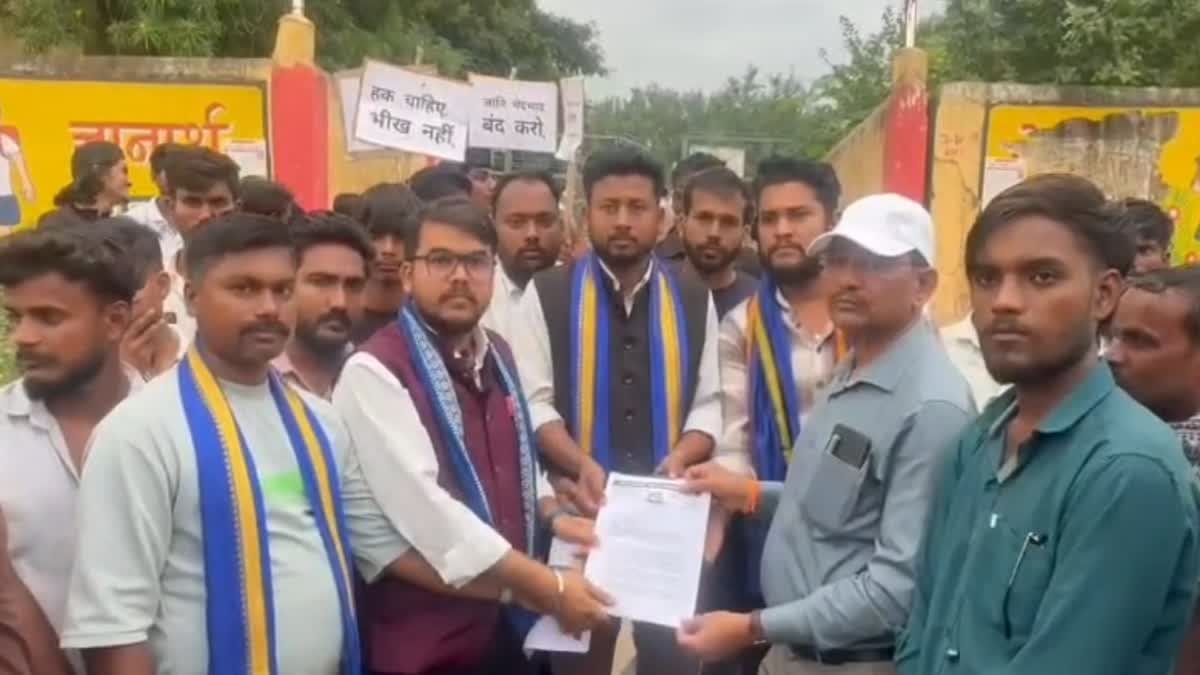
On Tuesday 6 October Bhim Army members protested for about an hour at the school’s main gate. “This act is a direct, open insult to Dalit society and shows the feudal mentality of untouchability,” Nalanda told People’s Update (all quotes from Hindi sources are translated by The Dalit Project). The group asked for punitive and legal action against the in-charge principal.
The in-charge principal calls the allegations baseless: the water sprinkled was the water offered during the puja. “Any allegation of purification or discrimination is completely fabricated and false,” he told Dainik Bhaskar. He told Navbharat Live that the allegation of purifying anyone’s chair or the office was “completely wrong and fabricated”, and told People’s Update that the allegations were “malicious” and that there had been no intention of purification or caste discrimination. He told ETV Bharat the water was sprinkled on the image, not around the room, and told Khabar Digital he had sprinkled it on himself, as is done in worship, and that adding a caste angle was wrong.
Roshanlal Rawat, the tahsildar of Amarpatan, the subdistrict’s revenue officer, came to the protest and took Bhim Army’s memorandum. “The entire sequence of events and the video will be investigated impartially at the administrative level,” he told Dainik Bhaskar, with action “according to the rules” on whatever it finds. On 11 October Satish Choubey, state secretary of the Akhil Bharatiya Brahmin Samaj, a Brahmin caste association, said an ordinary Saraswati puja was being given a caste colour; the association warned of an agitation if the principal was punished “under pressure”. On 11 October the inquiry’s report was still awaited; no result and no police case had been reported in the coverage The Dalit Project found by 18 October.
The mechanism: a seat that can be polluted
Untouchability in India was never only about touch. It ranked people by birth and then regulated where their bodies could go, what they could share and what their presence did to a place. A purification ritual is the last step of that logic: it presumes that a Dalit person’s presence left something behind that has to be washed away.
Akhilesh Kumar, a PhD scholar at Jamia Millia Islamia and an Ambedkarite activist, put it this way in an essay for Round Table India after Haldwani: when a public space is purified after a Dalit has occupied it, “it suggests that the presence of a particular social body has altered the status of the space.”
That is what makes a chair different from a temple or a well. The office of a school principal is not a caste space. It is a public post in a government school. Verma held it, by the reports, until the day he retired. If it was cleansed after him, the ritual did not exclude him from anything; it reclassified, after the fact, the time a Dalit had spent in authority.
6 months: the longest prison term section 7(1) of the Protection of Civil Rights Act allows for encouraging untouchability “in any form whatsoever”, including by “signs or by visible representations” Source: Protection of Civil Rights Act 1955, section 7(1)
A pattern Dalit leaders have named
The Maihar allegation is the newest in a sequence that Dalit public figures have described in their own words.
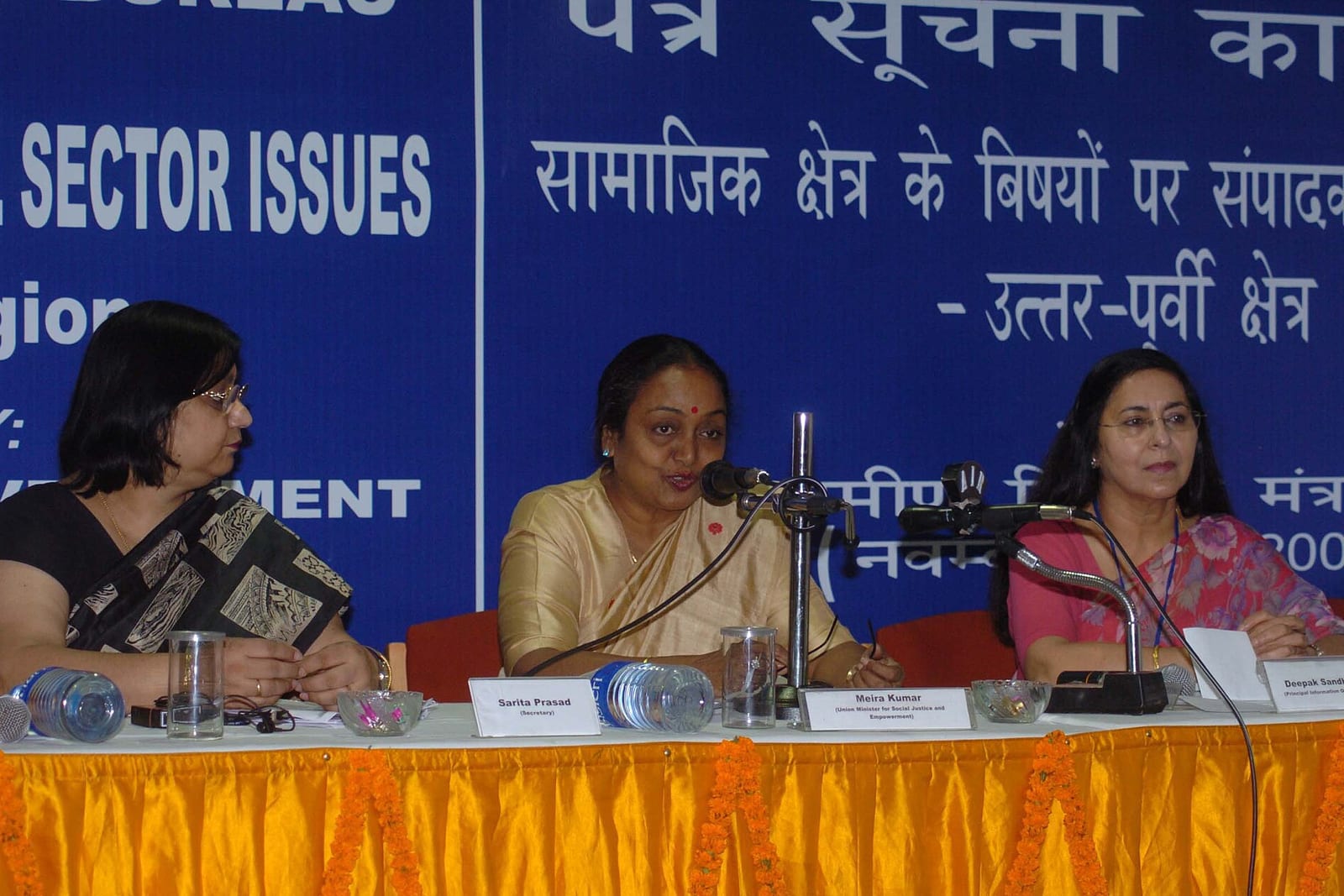
In August 2022 Meira Kumar, a former Speaker of the Lok Sabha, Parliament’s lower house, recalled what happened in 1978 when her father, the Dalit politician Jagjivan Ram, unveiled a statue of Sampurnanand, a former chief minister of Uttar Pradesh. A crowd shouted a casteist slur at him, she said, and told him to go away.
“And they washed the statue with Ganga Jal. Because it was polluted. So you see, the caste system embraces everyone.”
— Meira Kumar, former Speaker of the Lok Sabha, as reported by Scroll, August 2022
This August it was Mallikarjun Kharge, the Congress party president, who is Dalit. Two days after his rally at Ramlila Maidan in Haldwani, in the northern state of Uttarakhand, members of the Shri Ram Sena Dharmarth Seva Nyas Sangathan performed a purification havan (Round Table India), a fire ritual, at the venue, citing the rally’s slogans and Kharge’s criticism of the Bharatiya Janata Party (BJP) and the Rashtriya Swayamsevak Sangh (RSS) as their reason. In the Rajya Sabha, Parliament’s upper house, Kharge said the ritual had made him “feel the sting of untouchability”. Police registered a case only on 8 September, against unknown persons, and the chair of the National Commission for Scheduled Castes (NCSC), India’s constitutional body for Dalit rights, later said the material it examined showed no “caste-based malice” and that the matter was “politically motivated”, as The Dalit Project reported.
A statue, a rally ground and, Bhim Army alleges, a principal’s chair: in each case the cleansing, as described, followed a Dalit person’s presence in a place of public standing, not a private home. The higher the office, the more pointed the message that office does not change caste.
What the law says
Article 17 of the Constitution abolishes untouchability and forbids “its practice in any form”, as our explainer quotes it. The Protection of Civil Rights (PCR) Act of 1955, explained here, turns that into crimes. Its section 7 punishes anyone who, “by words, either spoken or written, or by signs or by visible representations or otherwise”, encourages “any person or the public generally to practice untouchability in any form whatsoever”, and anyone who “insults or attempts to insult, on the ground of untouchability, a member of a Scheduled Caste”, the legal category that covers most Dalits. The sentence is one to six months in prison and a fine.
A purification ritual performed on camera in a public office after its Dalit holder has left, if that is what happened, would be the kind of “visible representation” the section names. Whether that is what happened in Maihar is the question the inquiry will have to face.
The counter-reading
The strongest case against the allegation is the in-charge principal’s own: the puja to Saraswati followed the school’s old tradition, he says, the water came from that puja, and Verma was given a respectful farewell. The Brahmin Samaj makes the same case, and the Scheduled Castes commission’s finding on Haldwani shows that a constitutional body can look at a purification and see politics, not caste.
That reading would settle the matter if intent were the test and the actor’s account were the evidence. Untouchability has never needed to announce itself, and the law does not wait for it to. The PCR Act punishes untouchability “in any form whatsoever”, and once an act it covers is shown against a member of a Scheduled Caste, its section 12 requires a court to presume the act was committed on the ground of untouchability, though the accused can rebut it. The question is not whether anyone announced a motive. It is what was sprinkled, where, and why the chair. His accounts, as three outlets report them, differ on where the water went: in the room (Navbharat Live), on the image (ETV Bharat), on himself (Khabar Digital). A video exists. An impartial inquiry has it to start from.
What to watch
- The tahsildar’s inquiry. Whether its findings on the video are made public, and whether they address the allegations about the chair and the ribbon as well as the puja.
- A police case. Whether a complaint is registered under the PCR Act or the Scheduled Castes and Scheduled Tribes (Prevention of Atrocities) Act, India’s 1989 law against caste violence. None had been reported by 18 October.
- The school department. Whether Madhya Pradesh’s school education department takes any view of what happened in the office of one of its schools.
- Haldwani. Whether Nainital police identify anyone in the case registered on 8 September.
Akhilesh Kumar ended his essay on Haldwani with a test that fits Karhi as well. The real test of equality, he wrote (Round Table India), “is whether, once they leave it, anyone still believes that the stage has been contaminated by their presence.” Verma has left his post. Whether his chair was treated as contaminated is what the inquiry, if its findings are made public, should tell.