Ambedkar, Phule, Periyar, and contemporary Dalit intellectuals as primary theoretical resources.
Showing —
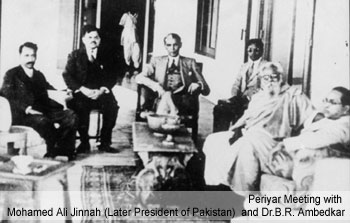
Ambedkar with Periyar E.V. Ramaswamy and Muhammad Ali Jinnah, Bombay, 1940 — the reform-versus-annihilation argument this piece revisits is Ambedkar's own, from the same era. — Wikimedia Commons, CC BY-SA 3.0
A decade after Rohith Vemula's death, India's higher-education regulator tried to institutionalize protection for Dalit students. The Supreme Court stayed it as unconstitutionally vague within sixteen days — proof, not disproof, of what Ambedkar argued ninety years ago.
Isabel Wilkerson's Caste made the caste-race comparison a bestseller in 2020. Ambedkar made it in a letter, seventy-four years earlier, to a man building the same argument from the other side of it — and the comparison has a real, checkable limit most versions of it skip.
Nobody says "caste" at the dinner table or the job interview anymore. Something still shapes who sits where and who gets called back. Caste didn't leave those rooms — it learned to speak in a different grammar.
When Navayana reissued Ambedkar's Annihilation of Caste in 2014, Arundhati Roy's introduction ran longer than the text itself. What that says about who gets to explain Ambedkar to a general reader.
The most durable account of where caste comes from was written by a 25-year-old at a Columbia seminar in 1916. Ambedkar isolated a single mechanism — endogamy — as caste's essence, and made a century of subsequent theory look like elaboration around a missing centre.