Political movements are usually named by their founders. India’s newest one was named, inadvertently, by a judge. On May 15, Chief Justice Surya Kant remarked during a Supreme Court hearing that some unemployed youth become “cockroaches” and “parasites” who attack institutions through social media activism and litigation. He later said his comments were aimed at those with fake degrees, and that he was taken out of context. But by then Abhijeet Dipke, a 30-year-old political communications strategist, had posted a question on X: “What if all the cockroaches come together?”
The answer arrived quickly. The Cockroach Janta Party (a caricature of a party, unregistered, built on self-mockery and memes) amassed more than 20 million Instagram followers within days, eclipsing both the ruling Bharatiya Janata Party and the Indian National Congress. The name itself is a parody of the BJP’s. Its central demand is the resignation of the education minister, Dharmendra Pradhan, over alleged paper leaks and irregularities in national examinations affecting more than 10 million students. In late June, Dipke sat with supporters at Jantar Mantar, Delhi’s designated protest ground, pressing that demand. The party’s X account subsequently became inaccessible within India while remaining visible abroad, a development that alarmed opposition figures concerned about free expression, and one that did more to certify the movement as a threat than any manifesto could.
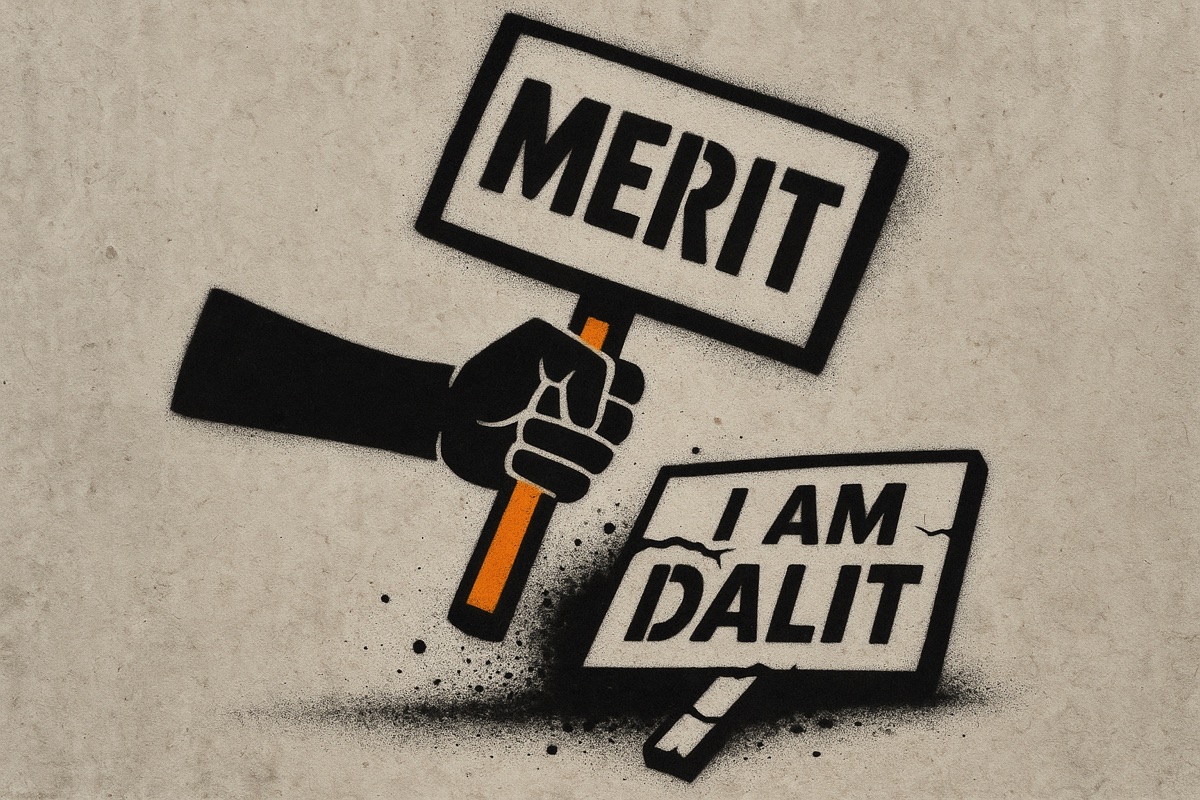
For readers of this magazine, one detail in Dipke’s biography deserves more attention than it has generally received. He grew up in a Dalit family in Maharashtra (Dalits being the communities once branded “untouchable,” roughly 200 million people at the base of South Asia’s caste hierarchy), a middle-class household in Chhatrapati Sambhajinagar, the city formerly known as Aurangabad. Most coverage treats this as background color. The movement’s own materials barely mention caste: its stated grievances are corruption and the shortage of opportunities for young people, material and generational, not caste-coded. “In India, if you’re rich, the system dances at your fingertips,” Dipke told NPR. “If you’re poor, nobody will be there for you.” Rich and poor; not savarna and Dalit.
It would be tempting to read this silence as erasure: a Dalit founder obliged to de-caste his politics to hold a cross-caste audience of 20 million. But the record resists that reading. Dipke signs his communications “#JaiBhim,” the Ambedkarite salutation, and when he flew back from Boston in June to lead the Jantar Mantar protest (reportedly prepared for arrest) he arrived visibly carrying a copy of B.R. Ambedkar’s biography and the Constitution of India. Those are not accidental props. To anyone literate in India’s political iconography, they announce a lineage: Ambedkar, the Dalit scholar who studied abroad, returned, and drafted the Constitution his community would use as its principal weapon. A Dalit founder from provincial Maharashtra, foreign-educated, coming home with Ambedkar in one hand and the Constitution in the other, is quoting that story deliberately (to those who can read it) while leading with unemployment for everyone else.
This is worth naming precisely, because it is genuinely new in scale if not in kind. The dominant Dalit political tradition of the past half-century (the Bahujan Samaj Party above all) foregrounded caste as the organizing frame: the thing the party was for. Dipke inverts the arrangement. Caste is present as idiom and inheritance, not as platform. Whether that represents a departure from Ambedkarite politics or its extension (Ambedkar himself, after all, framed annihilation of caste as a universal democratic project, not a sectional one) is the most interesting open question the movement poses. It matters practically, too: exam corruption and joblessness are not caste-neutral in their incidence. Leaked papers and purchased seats disproportionately injure first-generation aspirants without networks to fall back on, which is to say they injure Dalit, Adivasi and backward-caste students most. A movement can decline to say the word “caste” and still be, in effect, about it.
The skepticism the movement deserves runs in a different direction. Twenty million followers is the kind of number that gets repeated because it is large, not because anyone has established what it converts into. Attention is not organization; a follower is not a cadre, still less a voter. The global record of satirical politics cuts both ways (joke parties have occasionally won and governed, and digital youth surges from Kathmandu to Nairobi have toppled ministers) but the more instructive precedent is closer to home. Dipke formerly worked with the Aam Aadmi Party, which itself emerged from India’s anti-corruption movement in 2012: a movement that also once seemed to transcend the old categories, then became a party, then became a government, and then made the compromises governments make. Dipke has watched, from the inside, exactly how insurgent energy is institutionalized and spent. Whether that makes him likelier to avoid the trap or merely fluent in it is unknowable from here.
Two tests
Two tests will tell. The first is durability: whether the movement’s demands outlive the exam-leak scandal that supplied its first march, or dissolve once the minister survives or is sacrificed. The second is the caste question itself: whether a movement with a Dalit founder and an Ambedkarite grammar can keep caste implicit as it grows, or whether the moment it contests power, India’s political system, which allocates tickets, alliances and attacks by caste arithmetic, forces the subtext to the surface. The chief justice’s insult was aimed at the jobless young in general. The reply is being led by a man whose community has heard the language of vermin before, and who has chosen, so far, to answer for everyone. Whether Indian politics will let him keep that choice is another matter.
A system that sorts everything by caste arithmetic has rarely let a Dalit leader speak for everyone very long, whatever he carries to the protest in his hands.